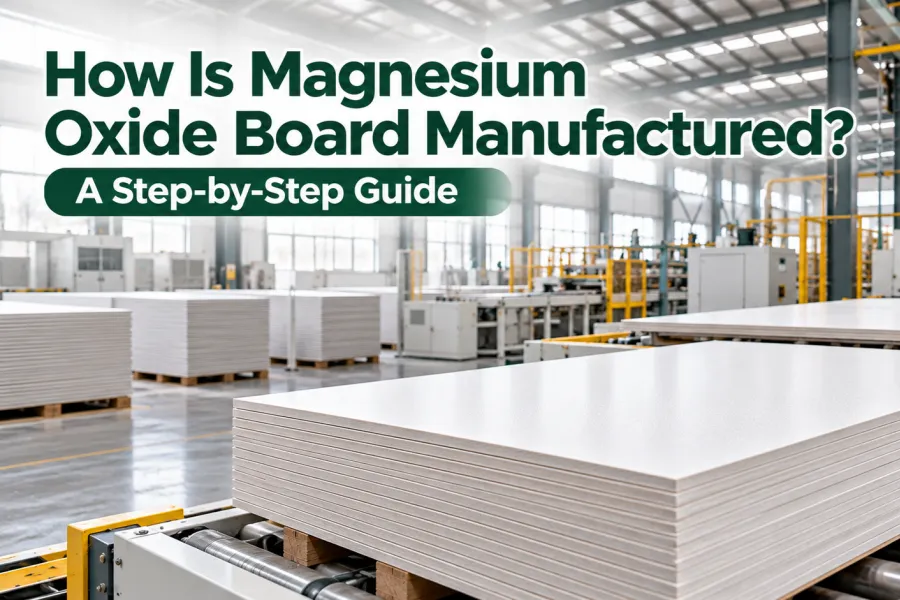
Magnesium oxide (MgO) board is a versatile building material manufactured by combining magnesium-based cementitious materials with reinforcing fabrics and selected fillers. Its final properties depend on the raw materials, formulation, forming process, curing conditions, and subsequent finishing operations.
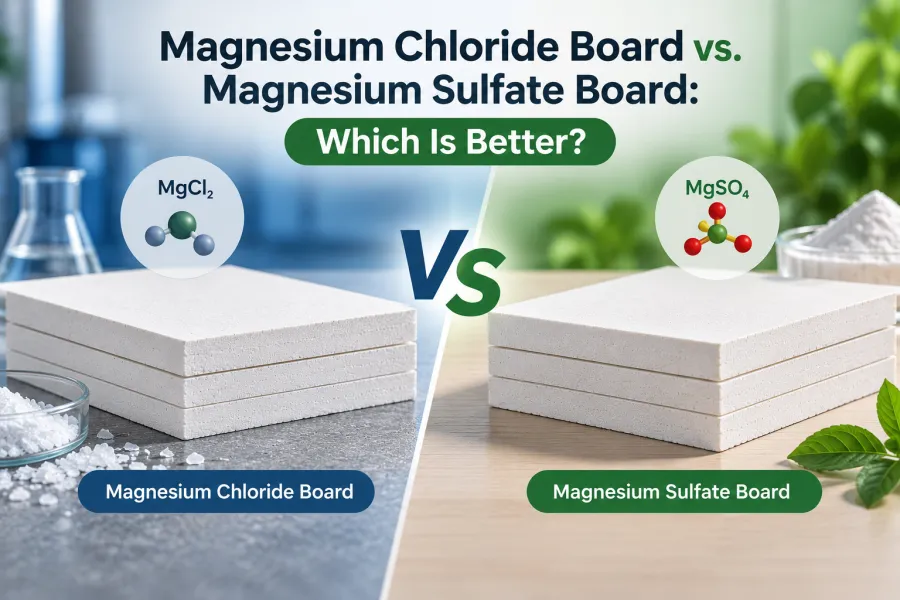
Although magnesium oxide boards made with different formulations share many manufacturing steps, magnesium sulfate boards and magnesium chloride boards require different process considerations, particularly when it comes to soluble salt management and moisture control.
Understanding how MgO board is manufactured helps builders, distributors, and project owners evaluate product quality and select suitable boards for their applications.
1. Raw Material Preparation
The manufacturing process begins with the preparation and inspection of raw materials. The selection and proportioning of these materials influence the board’s strength, density, dimensional stability, and other performance characteristics.
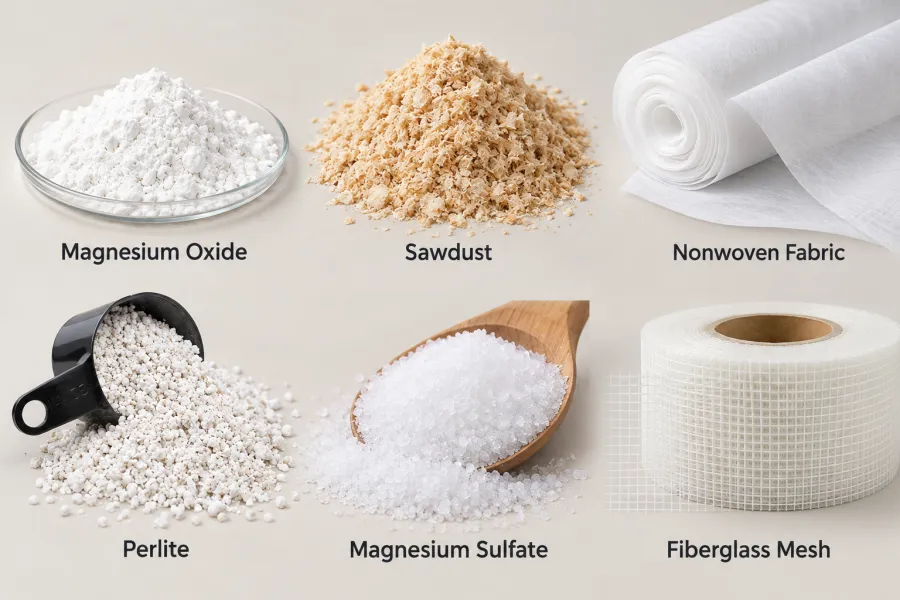
Common raw materials used in MgO board production include:
- Magnesium oxide (MgO): The primary mineral component in the cementitious system.
- Magnesium sulfate (MgSO₄) or magnesium chloride (MgCl₂): Used to form the magnesium-based cementitious binder.
- Sawdust: Used as a lightweight organic filler in the formulation.
- Perlite: A lightweight mineral material that can help reduce board density and modify its physical properties.
- Fiberglass mesh: Provides reinforcement and helps improve the board’s resistance to cracking and mechanical stress.
- Nonwoven fabric: Incorporated into the board structure as part of the reinforcement system.
Before production, the raw materials are prepared and measured according to the selected formulation. Consistent material quality and accurate proportioning are essential for maintaining uniformity between production batches.
2. Mixing the Raw Materials into a Slurry
After preparation, the raw materials are mixed to produce a uniform cementitious slurry suitable for board forming.
The magnesium salt is prepared in an aqueous solution, which is then combined with magnesium oxide and the other ingredients according to the production formula. The mixture is thoroughly blended until it reaches the required consistency.
A uniform slurry helps distribute the ingredients evenly throughout the board. Inconsistent mixing may result in variations in density, surface quality, or mechanical properties.
The formulation and mixing conditions must be appropriate for the selected magnesium salt system. Magnesium sulfate and magnesium chloride have different chemical characteristics, so their proportions and processing requirements should not be assumed to be interchangeable.
3. Incorporating Fiberglass Mesh and Nonwoven Fabric
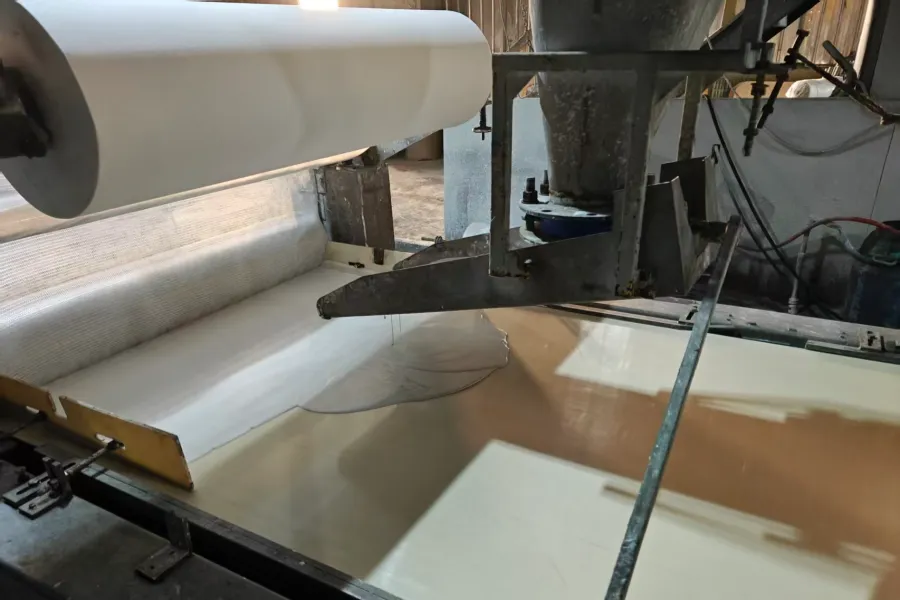
Fiberglass mesh and nonwoven fabric are incorporated into the board during the forming process.
Fiberglass mesh is an important reinforcement material. When properly embedded in the board, it helps improve tensile strength and resistance to cracking. Its positioning, distribution, and compatibility with the cementitious matrix influence the reinforcement performance of the finished product.
Nonwoven fabric is used to support the slurry during the board-forming process and help create a smooth, even surface. It provides a supporting layer that helps maintain the board’s surface quality and consistency during manufacturing.
During this stage, the slurry and reinforcing materials must be combined carefully to achieve the intended layer structure and minimize defects such as wrinkles, uneven coverage, or poorly bonded areas.
4. Board Forming
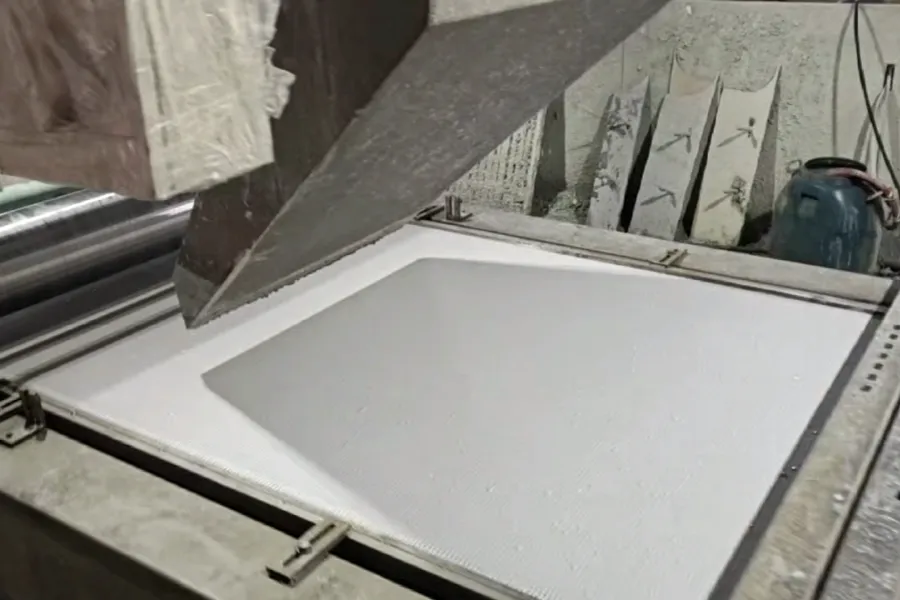
The slurry is distributed onto the molds, while the fiberglass mesh and nonwoven fabric are positioned according to the required structure. The material is then leveled and formed to achieve the specified thickness and dimensions.
The forming process must provide consistent material distribution and adequate integration between the slurry and reinforcement layers.
Important factors include:
- Uniform slurry distribution
- Accurate thickness control
- Correct positioning of reinforcement materials
- Consistent board structure
- Proper handling of the freshly formed board
At the end of this stage, the material has taken the shape of a board but has not yet developed all the properties required of the finished product. It must undergo curing before further processing.
5. First-Stage Curing in a Controlled Environment
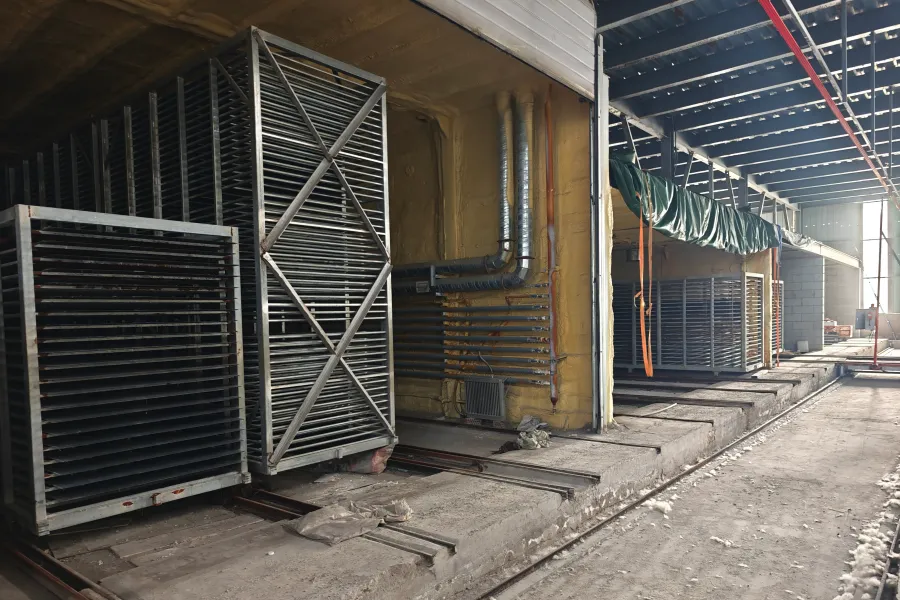
After forming, the newly produced boards enter the first curing stage.
During this stage, the boards are placed in a curing room where temperature and humidity are controlled. These conditions help the cementitious system develop sufficient initial strength for subsequent demolding.
The curing environment is important because the early hardening process affects the board’s ability to maintain its shape and withstand handling.
Insufficient initial curing may make the boards more vulnerable to edge damage, deformation, or other defects during demolding. Conversely, inappropriate curing conditions may affect the development of the cementitious structure.
The required curing time and environmental conditions depend on the formulation, board thickness, and production process. They should be established through manufacturing experience and process validation rather than applied as a universal setting for every type of MgO board.
6. Demolding
Once the boards have developed sufficient initial strength, they are removed from their molds.
At this stage, the boards have hardened enough for handling, but they may still require additional curing to develop their intended properties.
Proper demolding helps reduce production defects and prepares the boards for the next stage of the manufacturing process.
7. Second-Stage Curing at Room Temperature
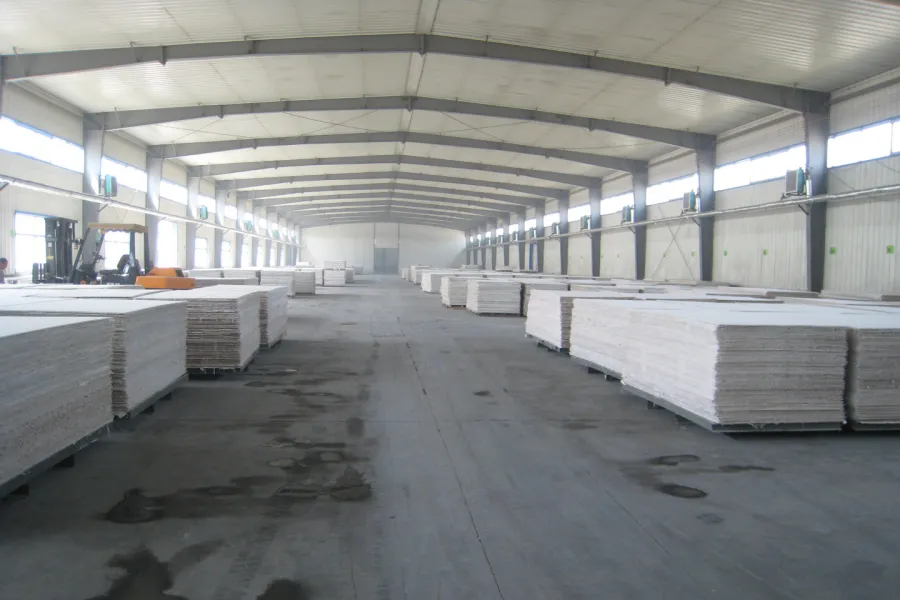
After demolding, the boards are transferred to a warehouse or designated curing area for the second stage of curing.
Unlike the first stage, which takes place in a controlled curing room, this stage is carried out under room-temperature conditions according to the factory’s established process.
During second-stage curing, the cementitious matrix continues to develop and stabilize. Adequate curing time is important for achieving consistent strength and reducing the risk of premature processing or handling damage.
The duration of this stage depends on the board formulation, thickness, environmental conditions, and required performance.
Curing should not be confused with drying. Curing allows the cementitious system to develop its properties, whereas drying primarily concerns the removal of excess moisture. Both processes may be necessary to obtain a stable finished board.
8. Optional Water Immersion Treatment for Magnesium Chloride Boards
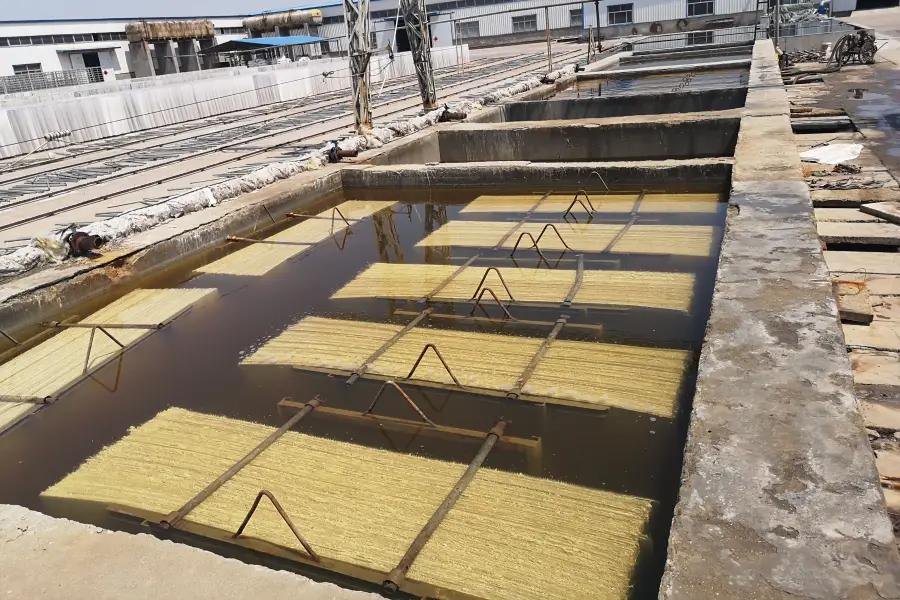
Some magnesium chloride-based MgO boards undergo an additional water immersion treatment as part of their manufacturing process.
Magnesium chloride boards may contain soluble chloride salts that have not been fully incorporated into the cementitious structure. Under unsuitable conditions, these salts can contribute to moisture-related problems, including surface moisture accumulation and corrosion of susceptible metal components.
Where appropriate for the formulation, controlled water immersion can help remove some water-soluble salts from the board. The effectiveness of this treatment depends on factors such as the board composition, water conditions, immersion procedure, and subsequent drying.
Water immersion is not a universal requirement for every magnesium chloride board. It should be treated as a formulation-specific process rather than a substitute for correct raw material proportions and proper curing.
Magnesium sulfate boards generally follow a different process approach and do not automatically require the same immersion treatment.
For manufacturers, the objective is not simply to add a washing step, but to achieve a stable board with suitable moisture behavior and controlled soluble salt content.
👉️ Check the differences between magnesium sulfate boards and magnesium chloride boards
9. Drying and Moisture Stabilization
After curing, the boards proceed to drying and moisture stabilization. The objective is to bring the board to an appropriate moisture condition for subsequent processing and storage.
Excessive residual moisture may affect dimensional stability, surface quality, and the performance of certain finishing materials. However, drying should be controlled according to the board’s formulation and characteristics rather than treated as a process of removing all moisture indiscriminately.
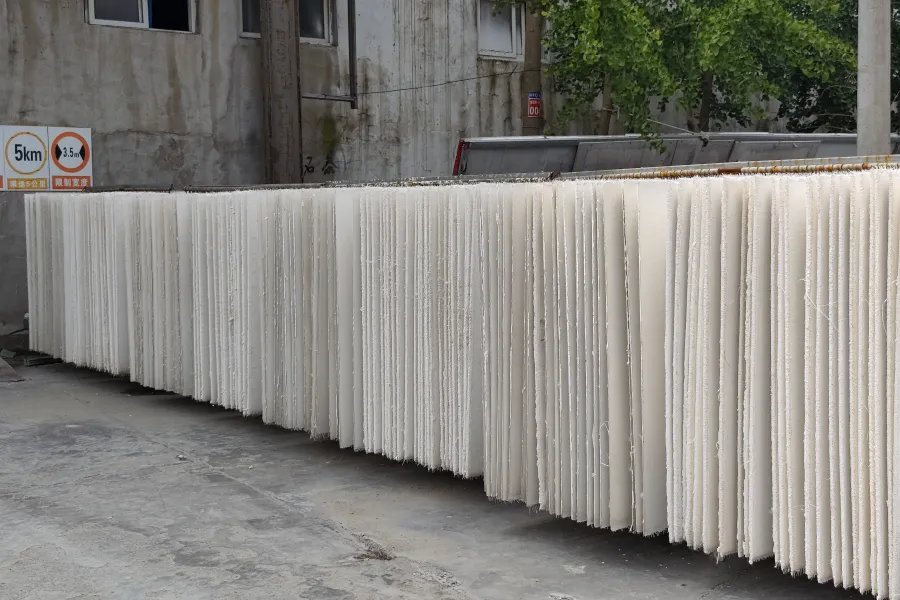
10. Cutting and Surface Finishing
Once the boards have reached the required processing condition, they are cut to the specified dimensions using industrial cutting equipment.
Standard sizes, thicknesses, and tolerances depend on the product specification and customer requirements. Accurate cutting helps ensure that boards can be installed and assembled efficiently on site.
Additional finishing operations may be carried out depending on the intended application, including:
- Sanding: To improve surface smoothness.
- Edge finishing: To produce the required edge profile.
- Grooving and profiling: For applications requiring specific joint or installation details.
- Lamination: To apply decorative finishes, such as PVC films with wood-grain or stone-grain patterns.
- Other customized processing: According to the customer’s drawings and technical requirements.
Not every MgO board requires all these operations. The finishing process is selected according to the board type and its intended use.
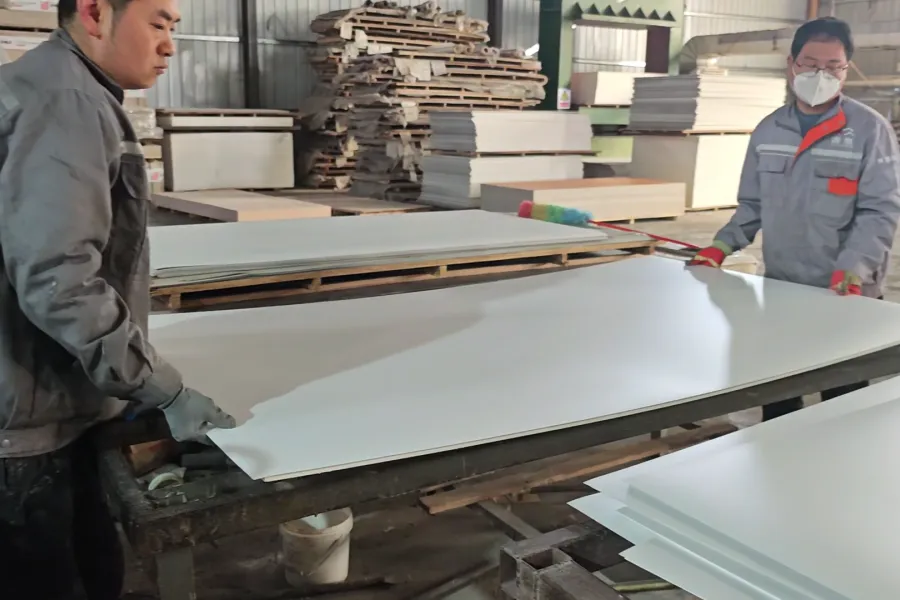
11. Quality Inspection and Packaging
Before packaging, finished MgO boards should undergo inspection to verify that they meet the applicable product specifications.
Depending on the product and intended application, quality checks may include:
- Dimensions and thickness
- Density and weight
- Surface appearance and edge condition
- Moisture content
- Mechanical properties
- Water absorption and dimensional stability
- Soluble chloride content, where relevant to the product specification
- Fire performance and other required properties, supported by appropriate test reports
The specific inspection items and acceptance criteria depend on the applicable standards, customer requirements, and product type.
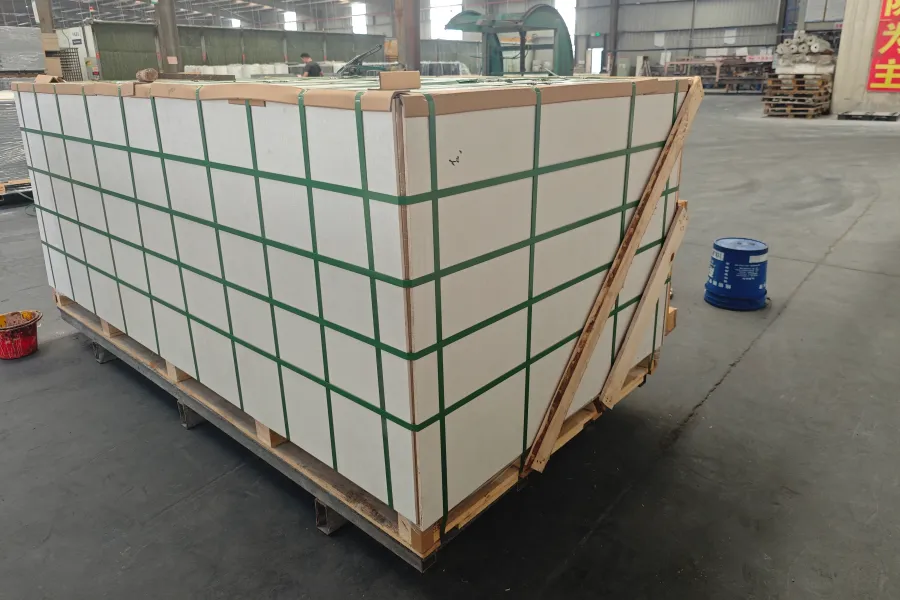
Once the boards have passed the required inspections, they are packaged and prepared for storage or shipment. Appropriate packaging and handling help protect the board surfaces and edges during transportation.
Quality control is not limited to the final inspection. Consistent raw materials, accurate mixing, proper forming, suitable curing, and controlled moisture management all contribute to the quality of the finished product.
What Is the Difference Between Magnesium Sulfate and Magnesium Chloride Board Manufacturing?
Magnesium sulfate board and magnesium chloride board use different magnesium salt systems. Although their general production sequences are similar, their formulations and processing requirements differ.
| Manufacturing consideration | Magnesium sulfate board | Magnesium chloride board |
|---|---|---|
| Cementitious system | Magnesium sulfate-based | Magnesium chloride-based |
| Mixing | Uses a magnesium sulfate solution | Uses a magnesium chloride solution |
| Forming and reinforcement | Slurry is combined with reinforcing materials | Slurry is combined with reinforcing materials |
| Curing | Requires suitable initial and subsequent curing | Requires suitable initial and subsequent curing |
| Water immersion | Not normally a standard requirement | May be used as a formulation-specific treatment |
| Moisture and salt management | Requires appropriate formulation and moisture control | Requires particular attention to soluble chloride management |
| Quality verification | Depends on product specifications and intended use | Includes appropriate evaluation of chloride-related risks where relevant |
Neither the magnesium salt system nor the manufacturing process alone guarantees the quality of a finished board. Raw material quality, formulation, production controls, curing, and verified performance all matter.
For this reason, buyers should evaluate MgO boards using relevant technical data, test reports, and application requirements rather than relying solely on the product name.
Conclusion
The manufacturing process of magnesium oxide board involves a series of interconnected steps, from raw material preparation and slurry mixing to reinforcement, forming, curing, moisture stabilization, cutting, and finishing.
Each stage contributes to the quality and consistency of the finished product. Careful formulation, suitable curing conditions, and appropriate moisture and soluble salt management are particularly important when producing different types of MgO boards.
Understanding the relationship between manufacturing processes and product performance is essential to supplying boards for different construction applications.
If you are looking for magnesium oxide boards for your project, contact our team to discuss your required thickness, dimensions, board type, and application. We can help you identify the relevant product specifications and technical information for your needs.