- 1. What Are Magnesium Chloride Boards and Magnesium Sulfate Boards?
- 2. Key Differences Between Magnesium Chloride and Magnesium Sulfate Boards
- 3. Why Do Some MgO Boards Develop Moisture Problems?
- 4. Does Magnesium Sulfate Board Always Perform Better?
- 5. How to Choose the Right MgO Board for Your Project
- 6. How to Choose a Reliable MgO Board Manufacturer
- 7. FAQs
- 8. Conclusion: Is Magnesium Sulfate Board a Better Choice?
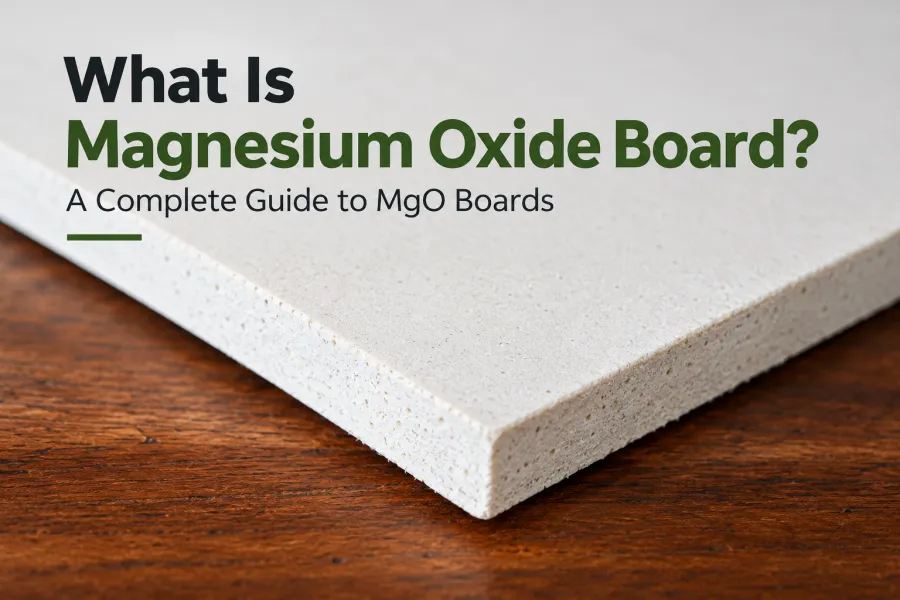
Magnesium oxide (MgO) board has become an increasingly popular building material thanks to its fire-resistant properties, versatility, and potential for more sustainable construction. However, not all MgO boards are manufactured using the same chemical system. Two of the most common types are magnesium chloride board (MgCl₂ board) and magnesium sulfate board (MgSO₄ board).
Although both use magnesium oxide as a primary raw material, the different magnesium salts used in their production can affect moisture behavior, chloride content, corrosion risk, and long-term durability.
So, which type is better for your project?
In this article, we explain the differences between magnesium chloride and magnesium sulfate boards, explore the causes of common moisture-related problems, and provide practical advice for choosing the right MgO board for your application.
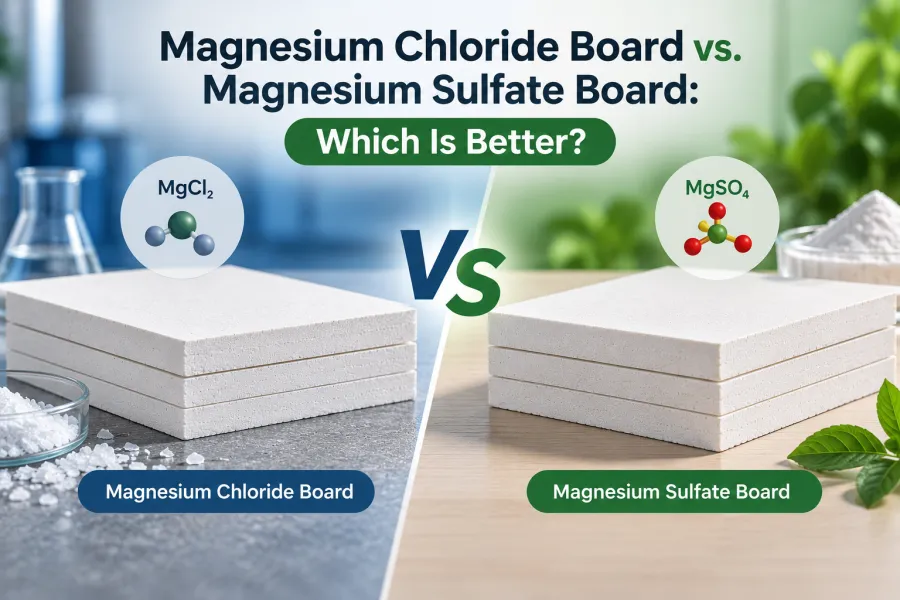
1. What Are Magnesium Chloride Boards and Magnesium Sulfate Boards?
What Is a Magnesium Chloride Board (MgCl₂ Board)?
Magnesium chloride board is a type of magnesium oxide board manufactured using magnesium oxide and magnesium chloride as the primary components of its binding system. Depending on the formulation, manufacturers may also incorporate fillers, reinforcing materials, and other additives to improve workability and mechanical properties.
During production, magnesium oxide reacts with magnesium chloride and water to form magnesium oxychloride cement, commonly known as MOC cement. This cementitious system binds the other components together to create a rigid board.
Magnesium chloride boards have been used in construction for applications such as interior wall panels, ceilings, partitions, and other building components.
However, their performance depends heavily on the quality of the raw materials, the formulation, the curing process, and the amount of residual or mobile chloride present in the finished product.
If the board contains excessive mobile chloride or is manufactured under unsuitable conditions, moisture-related problems may develop under certain environmental conditions.
What Is a Magnesium Sulfate Board (MgSO₄ Board)?
Magnesium sulfate board is manufactured using magnesium oxide and magnesium sulfate as the primary components of its binding system. It may also contain fillers, reinforcing materials, and functional additives, depending on the manufacturer’s formulation.
During production, magnesium oxide reacts with magnesium sulfate and water to form magnesium oxysulfate cement, commonly known as MOS cement.
Unlike the magnesium chloride system, the primary magnesium salt in this formulation is magnesium sulfate rather than magnesium chloride.
One important advantage of this approach is that it avoids relying on magnesium chloride as the principal binding salt, reducing the specific risks associated with chloride-containing brine when the formulation and manufacturing process are properly controlled.
However, magnesium sulfate board is not automatically immune to moisture damage. Its performance still depends on the quality of the magnesium oxide, the formulation, the curing conditions, and the properties of the finished board.
For buyers, the key is not simply to identify the chemical system, but to verify the actual performance of the product being supplied.
2. Key Differences Between Magnesium Chloride and Magnesium Sulfate Boards
The following table summarizes the main differences between the two types of MgO board.
| Comparison | Magnesium Chloride Board | Magnesium Sulfate Board |
|---|---|---|
| Main magnesium salt | Magnesium chloride (MgCl₂) | Magnesium sulfate (MgSO₄) |
| Cementitious system | Magnesium oxychloride cement (MOC) | Magnesium oxysulfate cement (MOS) |
| Chloride content | Chloride is an inherent part of the primary salt system | Magnesium chloride is not required as the primary salt, although trace chloride may be present |
| Moisture-related risks | Some formulations are susceptible to chloride-related moisture problems | Avoids the specific risks associated with magnesium chloride brine, but moisture performance still depends on formulation and production |
| Metal corrosion considerations | Mobile chloride can increase the risk of corrosion in susceptible metals | Generally offers an advantage where chloride-related corrosion is a concern |
| Mechanical strength | Depends on formulation, density, reinforcement, and curing | Depends on formulation, density, reinforcement, and curing |
| Dimensional stability | Must be evaluated through product testing | Must be evaluated through product testing |
| Fire performance | Requires verification through relevant fire tests | Requires verification through relevant fire tests |
| Production cost | Varies by raw materials, location, and manufacturing process | Varies by raw materials, location, and manufacturing process |
| Selection criteria | Product quality and suitability for the intended environment | Product quality, chloride control, and suitability for the intended environment |
The most important distinction is the chemistry of the binding system and the resulting chloride-related risks.
Magnesium sulfate board can be a particularly attractive option for applications where controlling mobile chloride is important. Nevertheless, buyers should compare actual test results rather than assume that every magnesium sulfate board will outperform every magnesium chloride board in every category.
3. Why Do Some MgO Boards Develop Moisture Problems?
Moisture-related problems are among the most frequently discussed concerns surrounding MgO boards. Understanding their causes can help buyers select more reliable products and avoid unnecessary maintenance costs.
The Role of Magnesium Chloride and Free Chlorides
Magnesium chloride is highly soluble in water and readily absorbs moisture from its surroundings. In some magnesium chloride board formulations, residual soluble chlorides can contribute to moisture accumulation on the board surface under unfavorable temperature and humidity conditions.
This may lead to visible moisture, salt deposits, or other surface changes. In certain assemblies, chloride-bearing moisture can also accelerate corrosion of susceptible metal fasteners, framing components, and other nearby materials.
However, these problems do not occur in every magnesium chloride board. The risk depends on factors such as the formulation, the amount and mobility of residual chloride, the curing process, the surrounding environment, and the details of the building assembly.
Magnesium sulfate board uses a different primary salt system and therefore avoids the specific mechanism associated with magnesium chloride brine. This can be a meaningful advantage when selecting a board for moisture-sensitive applications.
Nevertheless, it is important to distinguish between reduced chloride-related risk and complete waterproofing. A magnesium sulfate board may still absorb water or experience performance changes if it is poorly formulated, inadequately cured, or installed in an unsuitable environment.
How Manufacturing Quality Affects Moisture Resistance
The chemical system is only one part of the equation. Manufacturing quality also plays a major role in determining the long-term performance of an MgO board.
Important factors include:
- Raw material quality: The purity and reactivity of magnesium oxide can influence the formation of the cementitious structure.
- Formulation control: The proportions of magnesium oxide, magnesium sulfate or magnesium chloride, water, fillers, and additives affect the final material properties.
- Curing conditions: Temperature, humidity, and curing time influence the development of the cementitious phases.
- Reinforcement: Fiberglass mesh and other reinforcing materials can contribute to strength and dimensional stability.
- Quality consistency: Variations between production batches can lead to differences in density, strength, moisture behavior, and surface quality.
A reliable manufacturer should have a controlled production process and conduct appropriate inspections of the finished boards.
For importers and distributors, evaluating manufacturing quality is just as important as comparing the nominal chemical compositions of competing products.
How to Evaluate Moisture-Related Performance
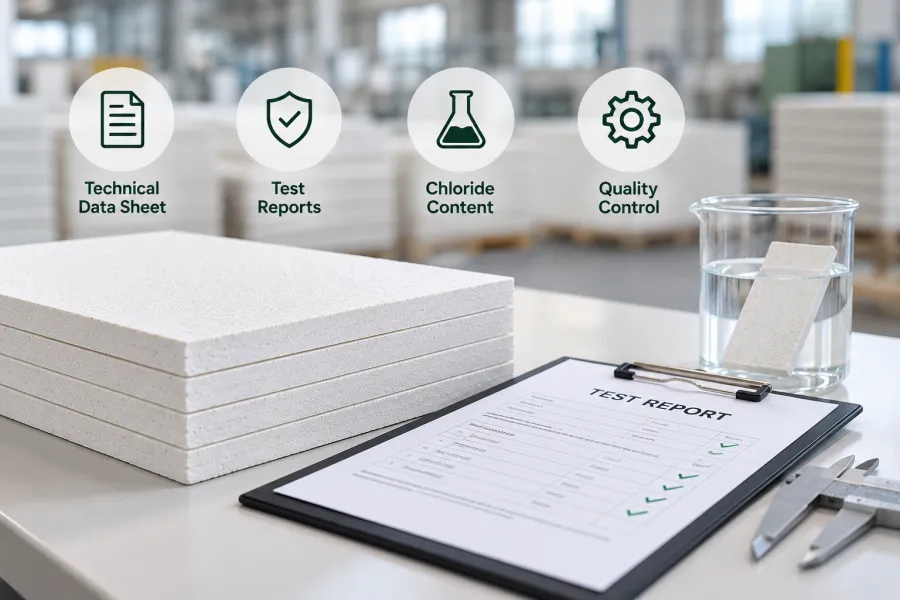
Before purchasing MgO boards for a project, ask the manufacturer for relevant technical data and test reports.
Depending on the intended application, useful information may include water absorption, dimensional changes after conditioning, wet and dry strength, and other moisture-related performance measurements.
For products intended for use with metal framing or fasteners, it is also worth asking about chloride content and, where appropriate, testing for soluble or leachable chloride.
Make sure the reported values correspond to a clearly defined test method. Total chloride content and leachable chloride content are different measurements and should not be treated as interchangeable.
Most importantly, do not rely solely on a manufacturer’s description of a product as moisture-resistant. Look for supporting test results and consider the expected exposure conditions of the finished assembly.

4. Does Magnesium Sulfate Board Always Perform Better?
Magnesium sulfate board has important advantages, particularly when reducing chloride-related moisture and corrosion risks is a priority. However, it would be inaccurate to conclude that the chemical system alone determines every aspect of board performance.
The Importance of Formulation and Curing
Both magnesium oxychloride and magnesium oxysulfate cementitious systems depend on appropriate formulation and processing conditions.
An improperly formulated or poorly cured magnesium sulfate board may have inadequate strength, dimensional instability, or unsatisfactory moisture performance. Conversely, a well-manufactured magnesium chloride board may perform adequately in applications for which its properties have been verified.
For this reason, buyers should consider the finished board rather than judging quality solely by the name of the magnesium salt used.
When comparing products, examine the board’s density, thickness tolerance, flexural strength, moisture-related test results, and other specifications relevant to the project.
Chloride Content and Corrosion Risk
One of the main reasons to consider magnesium sulfate board is the opportunity to reduce chloride-related concerns.
Magnesium sulfate does not introduce chloride as its primary binding salt. Nevertheless, the finished board may contain trace chloride from raw materials, process water, equipment, or other ingredients.
For applications where chloride control is important, ask for test results that clearly identify the measured property and test method.
If the manufacturer provides a leachable chloride result, confirm the units, the extraction procedure, and the acceptance criteria before comparing it with another product.
A documented low-chloride result provides more useful evidence than a general claim that a board is chloride-free.
Why Independent Testing Matters
Fire resistance, mechanical strength, and moisture performance should be assessed separately.
For example, a board’s chemical composition alone cannot establish whether it will meet the fire-resistance requirements of a particular wall, ceiling, or fire door assembly. Fire performance depends on the tested construction, including the board thickness, framing, joints, fasteners, insulation, and other system components.
Similarly, a high-density board is not automatically suitable for every flooring application, and a board that performs well in a dry interior environment is not necessarily appropriate for prolonged outdoor exposure.
Before specifying a product, review the available test reports and confirm that they apply to the intended board type, thickness, and application.
The most reliable purchasing decision combines an appropriate chemical system with verified product performance and consistent manufacturing quality.

5. How to Choose the Right MgO Board for Your Project
The best board depends on where it will be installed, what performance requirements it must meet, and how the completed assembly will be protected.
Interior Walls and Ceilings
For interior partitions and ceiling systems, consider fire performance, flexural strength, dimensional stability, surface quality, and compatibility with the proposed finishing materials.
Both magnesium chloride and magnesium sulfate boards may be considered, provided the selected product meets the project’s requirements.
For buildings where metal framing and fasteners are used, a board with verified low leachable chloride content may offer an additional advantage.
Flooring and Subflooring
Flooring applications require particular attention to load distribution, stiffness, fastening performance, thickness, and dimensional stability.
A board designed for wall applications should not automatically be used as a subfloor. The manufacturer should provide relevant technical data for the intended installation, including any required support spacing and fastening details.
Moisture exposure during construction and the expected service environment should also be considered.
Fire Doors and Fire-Rated Assemblies
For fire doors and other fire-rated constructions, the relevant fire-test evidence is essential.
The performance of an individual board does not establish the fire-resistance rating of a complete door or wall assembly. The entire tested construction must meet the applicable requirements.
Buyers should verify that the selected board is suitable for the tested assembly and that the thickness, density, and other product characteristics match the approved specification.
Humid Environments and Metal-Framed Systems
In environments where humidity fluctuates or metal components are present, chloride control and moisture-related performance deserve particular attention.
A properly manufactured magnesium sulfate board may be a suitable choice because it avoids relying on magnesium chloride as the primary binding salt.
However, neither magnesium sulfate chemistry nor a low-chloride test result makes a board automatically waterproof or suitable for unrestricted outdoor use.
For showers, wet rooms, exterior walls, and other demanding environments, evaluate the entire building system, including waterproofing, drainage, joint treatment, coatings, and installation details.
6. How to Choose a Reliable MgO Board Manufacturer
Selecting a suitable chemical system is only the first step. A dependable supplier should also be able to demonstrate product quality and provide technical support.
Check Technical Data Sheets and Test Reports
Request a current technical data sheet that specifies the board’s dimensions, thickness, density, mechanical properties, and other relevant performance indicators.
Depending on the application, ask for appropriate test reports covering fire performance, water absorption, dimensional stability, or other required properties.
Confirm that the reports relate to the actual product being offered, rather than a different formulation or board type.
Verify Chloride Content and Product Consistency
If low chloride content is a key purchasing requirement, ask the manufacturer to explain whether the reported value represents total chloride or leachable chloride.
Review the test method, units, and acceptance criteria. Where necessary, arrange independent testing through a qualified laboratory.
It is also advisable to assess production consistency by reviewing quality-control procedures and requesting representative samples before placing a large order.
Evaluate Manufacturing and Quality Control
A reliable manufacturer should be able to explain its raw material selection, production process, curing procedures, and finished-product inspection methods.
Ask how the manufacturer controls thickness, density, board flatness, surface defects, and batch-to-batch variation.
For large projects, consider conducting sample evaluations or trial installations before approving regular supply.
A supplier that understands both the material chemistry and the intended construction application can help reduce technical uncertainty and improve purchasing confidence.
7. FAQs
Can You Tell Magnesium Chloride and Magnesium Sulfate Boards Apart by Appearance?
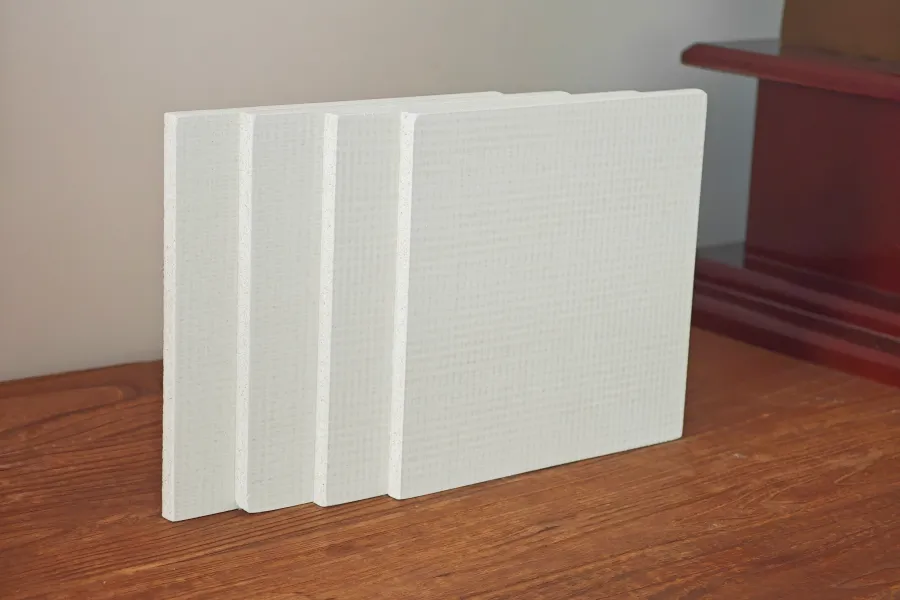
Magnesium chloride boards and magnesium sulfate boards generally look very similar. Both can have a light-colored surface, a relatively smooth finish, and a similar overall appearance. Depending on the manufacturer’s formulation and finishing process, there may be slight differences in color, texture, or surface quality, but these differences are not reliable indicators of the chemical system used.
Do Magnesium Chloride Boards and Magnesium Sulfate Boards Have Different Smells?
Both magnesium chloride boards and magnesium sulfate boards generally have a very mild odor. However, based on our manufacturing experience, magnesium chloride boards may have a slightly stronger smell than magnesium sulfate boards, although the difference is usually subtle.
8. Conclusion: Is Magnesium Sulfate Board a Better Choice?
Magnesium chloride board and magnesium sulfate board are both types of MgO board, but their different binding systems create important differences in material behavior.
Magnesium chloride board uses magnesium chloride as a primary component of its binding system. Under unfavorable conditions, residual soluble chlorides may contribute to moisture-related problems and increase corrosion risks for susceptible metals.
Magnesium sulfate board uses magnesium sulfate instead. This avoids the specific risks associated with magnesium chloride brine and can make it an attractive option for applications where chloride control is important.
However, the chemical system alone does not determine overall quality. Formulation, curing, density, reinforcement, manufacturing consistency, and verified performance all matter.
For buyers seeking an MgO board with reduced chloride-related risks, a properly manufactured magnesium sulfate board with documented test results is worth serious consideration.
If you have any questions about magnesium oxide board, product specifications, or its suitability for your project, feel free to contact our team. We’ll be happy to help.